Mars' Polar Ice Contains Far Less Dust Than Earlier Estimates Suggested
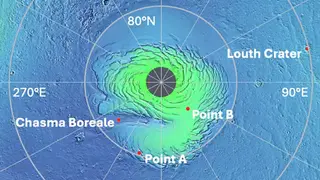
Researchers analyzing data from Mars orbital and lander missions found that water ice exposed at the Martian north pole contains less than 3% dust, substantially lower than previous estimates that ranged up to 25%. The team used a refined physical model to examine six polar locations and discovered that ice at the pole exists in layered patterns similar to a sandwich, with cleaner older ice exposed seasonally as dusty frost accumulates and melts. These findings have implications for understanding Mars' climate history, as the ice layers preserve records of climatic conditions from thousands of years ago.
Previous research on Martian polar ice relied on reflectance measurements from orbiting spacecraft and landers, but this indirect method yielded highly inconsistent results because the same light-reflection patterns could indicate very different combinations of dust levels, ice grain sizes, and layer structures. By applying a sophisticated physical model originally designed to study Earth's snow and ice, researchers were able to disentangle these overlapping factors and arrive at more precise dust measurements across six distinct north polar sites.
The sandwich-like structure revealed by the study—with seasonal frost layers alternating between cleaner ancient ice—acts as a geological record. These strata were deposited during Mars' dramatic climate oscillations, which occur because the planet's weak gravitational system causes extreme axial wobble over long timescales. Understanding the composition of these ice layers may help scientists reconstruct planetary climate patterns spanning thousands of years.
More accurate knowledge of polar ice composition could refine models predicting Mars' water availability for future human exploration and resource utilization. The findings may also improve climate simulations essential for understanding how Mars transformed from a potentially habitable world to its current state. Scientists studying planetary habitability and long-term climate stability could benefit from clearer data about how ice composition affects temperature and atmospheric interactions on Mars.