October 1, 1958: NASA's Founding Day Transfers Thousands from NACA to New Space Agency
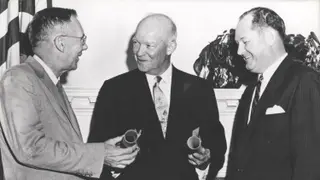
On October 1, 1958, the National Aeronautics and Space Administration officially began operations, with administrator T. Keith Glennan addressing the initial leadership in Washington while approximately 8,000 engineers, scientists, and technicians transitioned from the National Advisory Committee for Aeronautics to the new space agency. The transfer incorporated three major NACA laboratories at Langley, Ames, and Lewis, along with their budgets and existing missions, without requiring mass reassignments or physical relocations. The creation of NASA marked the end of a year of intense bureaucratic competition between military branches over control of America's space program and represented a fundamental shift toward civilian space exploration with the goal of competing with Soviet achievements in space.
The creation of NASA resolved months of intense institutional conflict within the U.S. government. Military branches competed aggressively for authority over space activities, with the Air Force arguing space was a natural extension of aviation, the Army leveraging its superior rocket expertise under Wernher von Braun, and the Navy defending its satellite program. This bureaucratic rivalry threatened to fragment American space efforts at a critical moment.
The transition from NACA to NASA preserved institutional continuity while fundamentally reorienting national purpose. Rather than disrupting operations, the transfer maintained three established research centers—Langley, Ames, and Lewis—along with their personnel and funding. This allowed the fledgling civilian agency to immediately pursue competitive space objectives against Soviet achievements without organizational upheaval.
The establishment of NASA may have influenced the trajectory of Cold War competition by consolidating space activities under civilian rather than military control. This structure could have affected the pace of space development, the allocation of resources between military and scientific objectives, and international perceptions of American space capabilities. The agency's creation potentially shaped decades of technological advancement and geopolitical strategy, though the long-term consequences of centralizing space authority remain subject to historical interpretation.