China Executes Dual Satellite Launches to Advance Megaconstellation and Military Programs
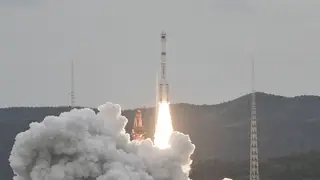
China completed two orbital missions in late September using Long March rockets, deploying the 26th batch of Guowang internet satellites and a fourth group of Yaogan-40 reconnaissance spacecraft. The Guowang constellation, comprising roughly 13,000 satellites in low Earth orbit, continues its expansion under state-owned China SatNet, while the Yaogan-40 program adds to its multi-plane reconnaissance network. These launches mark part of an accelerated cadence through the fourth quarter as Chinese space operators prepare for an intensive schedule.
China's space operations are accelerating dramatically toward an ambitious target of exceeding 100 orbital launches in a single calendar year. The dual September missions represent part of a sustained quarterly pace—with 70 attempts already completed through Q3—requiring at least 31 additional launches before year-end. The Guowang internet constellation and Yaogan-40 reconnaissance network represent distinct strategic objectives: commercial satellite internet coverage alongside military reconnaissance capabilities, both leveraging Long March variants operated from multiple launch facilities.
These concurrent programs could shape global telecommunications and surveillance capabilities for years ahead. The rapid deployment of megaconstellation satellites may accelerate competition in commercial space internet services, potentially affecting connectivity in underserved regions. Meanwhile, the systematic expansion of reconnaissance networks could influence strategic military positioning in space. Nations monitoring China's launch cadence and orbital architecture may adjust their own space strategies and investment priorities in response to demonstrated operational capacity and technological progress.