NVIDIA Vera Rubin GPU Achieves Significant Performance Gains for AI Agent Tasks
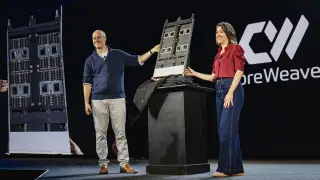
CoreWeave announced limited availability of NVIDIA Vera Rubin NVL72 systems, with Cognition's Devin AI agent demonstrating up to 4.8 times higher token throughput per GPU compared to baseline systems on software engineering inference workloads. The hardware improvements highlight how agentic AI systems require different infrastructure optimizations beyond raw model speed, including coordinated GPU, CPU, and networking resources. Cognition's production deployment on CoreWeave infrastructure represents an early validation of the new architecture's practical capabilities.
CoreWeave's infrastructure combines specialized hardware components designed to address the unique demands of AI agent systems. The Vera Rubin GPU delivers substantial throughput improvements for inference tasks, while the newly introduced Vera CPU focuses on accelerating sandbox environment initialization—a critical bottleneck when agents must repeatedly spawn isolated execution spaces during extended task chains. This pairing reflects a broader shift in semiconductor optimization toward systems that must coordinate multiple processing tiers simultaneously rather than maximizing single-component performance.
Cognition's deployment represents an early real-world test of whether these architectural innovations translate to practical advantages in production settings. The benchmarks measure raw token-processing speed, but the underlying value proposition centers on reducing latency across sequential reasoning steps that characterize autonomous agent workflows. As agentic AI systems become more prevalent in software engineering and other domains, demand for similarly specialized infrastructure could influence how cloud providers and hardware manufacturers design future systems.
If validated through broader adoption, specialized agent-optimized hardware could reshape infrastructure requirements across enterprise AI deployments, potentially benefiting cloud providers and semiconductor manufacturers positioned to supply such systems. Organizations deploying autonomous AI agents may face pressure to migrate workloads to compatible platforms, while those lacking access could experience competitive disadvantages in agent-dependent tasks. The focus on infrastructure efficiency rather than raw model capability could also shift discussions around AI advancement away from purely model-scaling approaches toward systemic hardware-software integration.