Scientists Detect Exotic Quasiparticles Carrying Fractional Electric Charge
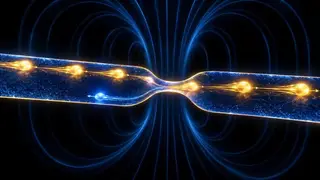
Researchers at the Weizmann Institute and EPFL have experimentally confirmed the existence of quasiparticles that carry approximately one-quarter of an electron's charge within a fractional quantum Hall state. These entities are not true particles but collective disturbances in electron systems that behave like particles in physical experiments. The discovery has potential applications in developing more robust quantum computers.
The experiment leveraged extreme conditions to observe quantum behavior impossible under normal circumstances. Researchers confined electrons to an ultrathin semiconductor layer, subjected them to powerful magnetic fields exceeding typical medical imaging equipment, and cooled the system to near absolute zero. Under these conditions, electrons abandon independent behavior and form interconnected quantum states where collective disturbances—quasiparticles—emerge with unusual properties.
The fractional quantum Hall effect reveals that charge itself can appear fragmented within these exotic states. The ν = 1/2 state studied here belongs to a rare category with even-denominator values, which theoretical physics suggests may contain non-Abelian anyons. These hypothetical quasiparticles possess unique quantum properties where the sequence of their interactions influences the system's overall state, distinguishing them fundamentally from conventional particles.
If validated further, this research could substantially advance quantum computing development. Non-Abelian anyons may enable topological quantum computers resistant to environmental interference, potentially solving a major obstacle preventing practical quantum systems. Such advances could impact industries relying on computation-intensive problems—pharmaceuticals, materials science, and cryptography. However, the technology remains in early experimental stages, and translating laboratory discoveries into functional devices typically requires years of additional research and engineering development.