Battery impact of iPhone's always-on display smaller than expected, testing reveals
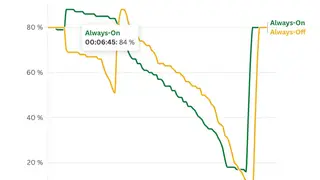
A two-week battery test on an iPhone 17 with iOS 27 demonstrated that the always-on display feature has a more modest impact on battery drain than commonly assumed. The device discharged at 4.27 percent per hour with always-on enabled versus 3.75 percent with the display off, a difference of roughly 0.5 percentage points that showed no statistically significant effect. The parallel discharge curves across both settings suggest users experience minimal real-world battery penalty for the convenience of the always-on display feature.
The testing methodology involved collecting battery readings at 15-minute intervals over a full two-week period using an iPhone 17 device, generating 672 separate data points for comparison. The researchers analyzed discharge patterns both across the entire 24-hour cycle and during peak usage hours between 8 a.m. and 11 p.m., finding consistent results across both timeframes. Apple's implementation of the always-on feature uses a 1Hz refresh rate when the device is locked, a technical specification designed to minimize power draw while maintaining the display's visibility.
The parallel nature of the discharge curves across both settings suggests that variable real-world conditions—including user behavior patterns, cellular signal strength, and ambient temperature—create sufficient battery variation to mask any meaningful difference between the two display modes. Statistical analysis using a t-test confirmed the findings lack statistical significance, indicating the always-on display operates within the normal operational variance of the device rather than as a major power drain.
These findings could influence consumer purchasing decisions and feature preferences for millions of iPhone users weighing the convenience of always-on displays against perceived battery concerns. The results may reduce anxiety among users concerned about battery longevity and could shift how technology reviewers and retailers communicate about this feature's trade-offs. The research could also establish a benchmark for how manufacturers communicate battery impact claims, potentially affecting competitive differentiation strategies across the smartphone market.