Boston Dynamics Redesigns Atlas Hand With Four Fingers for Manufacturing Tasks
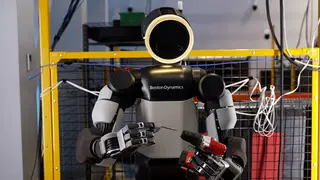
Boston Dynamics unveiled a new four-fingered hand for its Atlas humanoid robot that prioritizes reliability and tool manipulation over the dexterity of a five-fingered design. The hand features 13 degrees of freedom and direct actuation optimized for sim-to-real reinforcement learning, enabling capabilities like triggered tool grasps for drills and welding torches. The company determined that eliminating the pinky finger reduced complexity and power consumption without sacrificing the practical tasks required for manufacturing environments.
Boston Dynamics prioritized manufacturing utility over human-like appearance in its redesign. The team conducted a practical experiment where engineers taped their own pinky and ring fingers together to evaluate whether the missing digits would limit real-world tasks. This hands-on approach revealed that a four-finger configuration could handle the core operations needed in factory settings—including tool manipulation and precise grasping—while reducing system complexity and power demands compared to a five-finger alternative.
The new hand incorporates 13 points of articulation and relies on advanced actuation technology that maintains strength comparable to earlier versions despite the reduced finger count. Integrated pressure sensors across the fingertips and palm enable the robot to detect subtle contact signals, supporting both autonomous learning through simulation and physical dexterity during actual manufacturing work.
This development could accelerate the adoption of humanoid robots in automotive and industrial manufacturing by demonstrating that practical performance sometimes requires departing from biological templates. The focus on tool operation and reliability over general dexterity may establish a design precedent that makes manufacturing robots more accessible and cost-effective to deploy at scale. Workers in production environments may face evolving job landscapes, while manufacturers could experience gains in productivity and workplace safety depending on implementation strategies.