Ukrainian innovators deploy fiber-cutting barrier system against guided drones
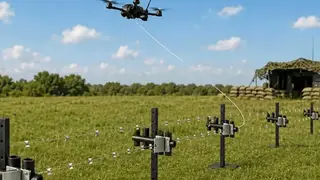
Ukraine has developed the Chaharnyk system, an acoustic-triggered motorized wire fence that catches and severs the fiber-optic control cables of Russian drones during flight. As Russia increasingly relies on fiber-guided drones with ranges up to 50 kilometers, this passive barrier technology offers a complement to existing net tunnel defenses protecting critical infrastructure. The system is battery-powered, portable, and can be remotely controlled to allow friendly aircraft passage.
Russia's shift toward fiber-optic guidance systems represents a strategic response to Ukraine's widespread radio-frequency jamming capabilities. Rather than transmitting commands wirelessly, these drones deploy kilometers-long fiber cables that feed operational data as the aircraft maneuvers, making them resistant to electronic countermeasures. The technology has scaled dramatically from experimental prototypes in 2024 to mass-produced variants capable of striking targets 50 kilometers distant.
Ukraine's layered defense approach combines physical barriers with cable-severing mechanisms. While net tunnels remain effective for protecting critical infrastructure along fixed routes, the Chaharnyk system addresses gaps in coverage—particularly sprawling facilities like electrical substations that would be impractical to enclose entirely. The acoustic trigger mechanism allows operators to disable protection selectively, accommodating friendly air operations.
The emergence of fiber-guided drone technology could reshape modern asymmetric warfare by reducing attacker dependence on electromagnetic spectrum control. Both defenders and attackers may face escalating costs as specialized countermeasures proliferate. Civilian infrastructure operators worldwide might consider similar protective systems, potentially normalizing automated anti-drone barriers around essential services. The conflict's technological evolution could influence defense procurement strategies globally, though system effectiveness in complex operational environments remains to be fully validated.