Researchers solve decades-old mystery of Venus's lower atmospheric haze
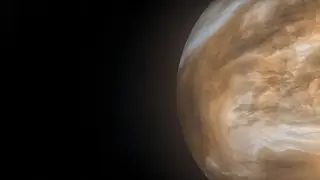
Scientists at Tohoku University have determined that Venus's yellowish lower haze, which has puzzled astronomers since the 1970s, is composed of cosmic dust particles from burned-up meteorites mixed with sulfuric acid. Using a microphysical model, researchers ruled out previous theories attributing the haze to volcanic ash or surface dust, finding instead that the continuous influx of interplanetary particles sustains the haze layer. The cosmic dust particles also act as efficient condensation nuclei, promoting cloud formation in Venus's main cloud deck.
Scientists have long puzzled over Venus's atmospheric composition since early space missions in the 1970s first detected the yellowish haze layer. The research team employed sophisticated computer modeling of cloud physics to understand how particles behave at microscopic scales, ultimately determining that meteorites continuously entering the planet's atmosphere provide the source material. When these space rocks plunge through Venus's dense atmosphere, friction burns them up and releases particles that remain suspended in the air.
The cosmic dust particles serve a critical function in Venus's weather systems. As sulfuric acid—abundant in Venus's atmosphere—condenses onto these meteorite remnants, the particles become seeds for larger cloud formations. Counterintuitively, an increase in these seed particles doesn't simply produce proportionally more clouds; instead, multiple particles cluster together before condensation occurs, creating heavier formations that eventually descend into the planet's lower regions.
This discovery may refine planetary science understanding of atmospheric processes across rocky planets and inform models of how celestial bodies evolve over time. For Venus exploration missions, identifying haze composition could improve instrument calibration and data interpretation. The research might also advance knowledge of how planetary atmospheres respond to continuous influxes of extraterrestrial material, potentially affecting long-term climate predictions and our understanding of planetary habitability factors.