Port Container Handlers Prove Battery Electric Feasible Despite Heavy-Duty Appearance
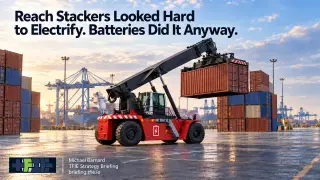
Battery-electric reach stackers, despite appearing to be ideal hydrogen fuel cell candidates due to their size and lifting capacity, are proving increasingly viable and cost-effective for port terminal operations. The global battery-electric reach-stacker fleet currently represents approximately 15-16% of the worldwide fleet with electric machines comprising nearly one-fifth of new production, demonstrating strong market adoption. These machines succeed with batteries because their actual energy consumption is modest relative to their weight, as they operate over short distances on paved surfaces with frequent braking and waiting periods that enable distributed charging throughout shifts.
Battery-electric reach stackers have achieved surprising market penetration despite their massive physical requirements. These machines, which can exceed 70 tonnes in weight before lifting additional cargo, operate in port terminals where energy demands concentrate in short bursts of acceleration and lifting rather than sustained high consumption. Their typical duty cycle—moving slowly across predictable terminal routes with frequent stops for loading and waiting—creates natural opportunities for charging during breaks, allowing operators to distribute power intake throughout the workday rather than requiring enormous onboard battery capacity.
Cost competitiveness is emerging as the decisive factor driving adoption. Industry analyses from 2023 projected battery-electric reach stackers would reach price parity with diesel equipment within five years as manufacturing scaled up. Current commercial deployments increasingly support this trajectory, with some operators reporting total cost of ownership advantages for electric models even now. The machines handle comparable workloads to diesel counterparts while eliminating fuel expenses and reducing maintenance requirements associated with traditional engines.
This technology shift could significantly reshape port operations' environmental footprint, as terminal equipment represents a concentrated source of emissions in global trade infrastructure. Widespread adoption may accelerate decarbonization timelines at major shipping hubs, potentially influencing supply chain sustainability across industries. Equipment manufacturers and port operators appear positioned to benefit from reduced operating costs, while communities near ports may experience improved air quality. The transition could also affect hydrogen fuel cell development priorities, directing investment toward other heavy-duty applications where battery solutions prove less practical.