Hubble Reaches 200,000 Orbits While Tracking Gravitationally Lensed Supernova
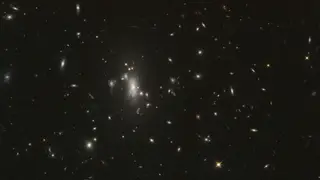
The Hubble Space Telescope achieved its 200,000th orbit around Earth on September 19, 2026, having accumulated over 1.7 million observations and traveled more than 8 billion kilometers during its 36 years of operation. On this milestone date, Hubble observed the gravitationally lensed supernova Athena in the galaxy cluster MACS J0417, which is expected to reappear in a different location by early 2027 due to the cluster's powerful gravitational lensing effect. These observations will help astronomers refine measurements of cosmic expansion and galaxy cluster mass distribution by tracking the supernova's timing and apparent motion.
The Hubble Space Telescope's latest observation demonstrates the continuing scientific value of space-based observatories more than three decades after launch. By monitoring a gravitationally lensed supernova, Hubble contributes to fundamental measurements of the universe's expansion rate and helps clarify the mass distribution within distant galaxy clusters. The supernova's expected reappearance through multiple light paths created by the cluster's gravity provides a natural experiment for testing cosmological models.
This observation exemplifies modern astronomy's reliance on coordinated observations across multiple wavelengths. While Hubble captures visible and ultraviolet light, the James Webb Space Telescope initially detected this supernova in infrared, creating a complementary dataset. The upcoming Nancy Grace Roman Space Telescope will further expand observational capabilities, suggesting that such collaborative observations will become increasingly central to advancing cosmological understanding.
The milestone highlights sustained technological achievement with potential practical implications for basic science funding and public understanding of space exploration. Hubble's continued productivity may influence decisions regarding telescope maintenance, successor missions, and resource allocation to astronomy. More broadly, precise measurements of cosmic expansion could eventually inform models of the universe's fundamental structure and evolution, though any applications remain far removed from immediate societal concerns.