Webb Telescope Examines Cosmic Collisions to Understand Early Solar System Formation
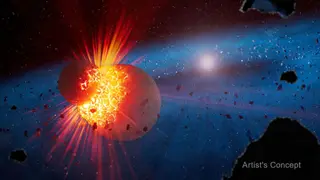
Using the James Webb Space Telescope, astronomers studied young stellar systems with extreme debris disks to better understand the violent planetary collisions that shaped our own solar system billions of years ago. The research focuses on massive impact events similar to the theorized collision between a Mars-sized object and the early Earth that is believed to have created the Moon. Findings published in The Astrophysical Journal provide insights into the composition and energy levels of these catastrophic collisions that played a crucial role in planetary evolution.
Astronomers have long theorized that Earth's formation involved a catastrophic collision with a Mars-sized planetary body, an event that fundamentally altered our planet's trajectory and ultimately led to the Moon's creation. By studying young star systems displaying extreme debris disks—characterized by unusually concentrated warm dust near their host stars—researchers can observe analogous violent processes occurring elsewhere in the universe today. These extreme debris disk systems remain remarkably scarce, with current observations suggesting only about 1% of young stars exhibit detectable signatures of this phase.
The research team successfully assembled a substantial sample of 21 such systems for analysis, combining archival data from NASA's earlier Spitzer Space Telescope with newly captured observations from Webb. This comparative approach allowed scientists to examine the composition and energy dynamics of these collision events across different stellar systems, providing empirical evidence that challenges some existing theoretical models about how frequently these dramatic planetary impacts should occur in young stellar environments.
Understanding the mechanisms behind planetary collisions may refine scientific models of how solar systems form and evolve, potentially informing assessments of planetary stability and habitability elsewhere. The research could enhance knowledge relevant to NASA's Artemis program, which aims to return humans to the Moon and establish a foundation for Mars exploration. Improved models of early solar system dynamics might also influence long-term strategies for understanding Earth's own formation and the prevalence of life-bearing worlds throughout the universe.