Developer Renders Classic Doom Game Entirely Through SQL Queries
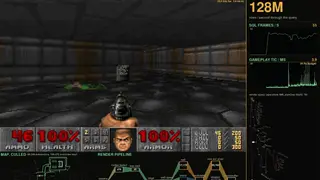
A developer successfully implemented the original Doom game using approximately 1,300 lines of SQL code combined with a Python client, generating full-color frames at 35 frames per second. The project converts Doom's level geometry into relational database tables and uses SQL queries to handle game logic and rendering. This represents a significant advancement over a previous attempt that produced only grayscale ASCII graphics similar to Wolfenstein 3D.
The SQLDoom implementation leverages the structural properties of Doom's original level design, which organizes game worlds into vertices, lines, and sectors—a format that translates naturally into relational database tables. The developer optimized performance by pre-computing sort keys during level loading, allowing simple SQL ordering statements to efficiently determine which visual elements to render each frame without recalculating complex spatial relationships.
This represents a notable progression from an earlier attempt that produced only ASCII-based graphics resembling the simpler Wolfenstein 3D engine. The new version achieves full-color 640×480 pixel rendering at playable framerates, demonstrating that modern database systems can handle real-time graphics tasks when paired with careful algorithmic design, despite the inherent overhead of database operations.
The project demonstrates how database architecture could potentially benefit multiplayer game servers by providing consistent state management and built-in concurrency handling. However, this remains primarily a technical proof-of-concept rather than a practical replacement for existing game engines. The work may interest database researchers and game developers exploring unconventional architectures, though performance limitations and complexity suggest traditional game engines will continue dominating production environments.