Structural Distinction in RNA Could Shed Light on Primordial Life Formation
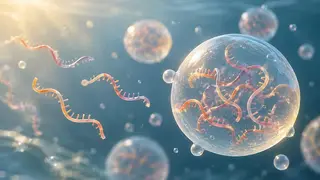
Research reveals that an extra oxygen atom on RNA's backbone enables the molecule to form dense, liquid-like droplets and gel-like networks far more readily than DNA. This chemical property may have allowed fragile RNA molecules to concentrate and organize themselves in the prebiotic world before cellular membranes evolved. The finding addresses a fundamental challenge in origins-of-life research regarding how the RNA world hypothesis could have functioned without the containment provided by modern cells.
The structural distinction between RNA and DNA hinges on a single chemical addition—an extra oxygen atom positioned along RNA's backbone. This minor modification produces dramatically different physical behaviors, particularly regarding how these molecules aggregate in solution. When heated in magnesium-containing environments, RNA spontaneously condenses into dense, liquid-like droplets through a process called phase separation, whereas DNA does not exhibit this property as readily. This phenomenon mirrors how oil naturally separates from water into distinct droplets.
The research addresses a central puzzle in understanding life's origins: how ancient RNA molecules could have functioned before cellular membranes existed. Modern cells rely on membrane-bound compartments to concentrate and organize molecular interactions. The discovery that RNA can self-organize into droplets and gel-like networks without external containment suggests a potential mechanism for early molecular chemistry to concentrate and organize itself in prebiotic environments, offering a plausible pathway for the proposed RNA world hypothesis.
This discovery may influence how scientists conceptualize early life's emergence, potentially reshaping educational frameworks and research priorities in astrobiology and biochemistry. If validated, understanding primordial RNA organization could inform synthetic biology efforts to create simplified life-like systems in laboratories. The findings might also have practical applications in biotechnology, where engineered RNA condensates could be used for drug delivery or molecular engineering. However, these remain speculative implications requiring substantial additional research before broader applications materialize.