AI's speed trap: How automation raises customer expectations while satisfaction lags
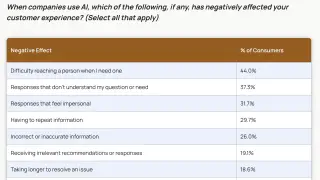
AI adoption has significantly heightened customer service expectations, with 58% of consumers expecting faster responses and 45% reporting raised overall expectations for companies using the technology. However, 89% of consumers report negative AI experiences, with the top complaint being difficulty reaching a human agent when automated systems fail to resolve issues. The disconnect reveals that speed alone cannot overcome poor AI implementation, particularly when customers face repeated information requests or unresolved problems.
The survey of over 2,000 U.S. consumers reveals a fundamental mismatch between AI capabilities and customer needs. While companies deploy automation primarily to reduce operational costs through decreased human involvement, consumers prioritize human accessibility as their top concern—44% struggle most with reaching an agent when systems fail. Additionally, the research highlights that speed improvements don't translate to satisfaction when customers encounter repeated problems, duplicate information requests, or unresolved issues that force them to restart interactions elsewhere.
The disconnect also stems from AI's technical limitations in understanding context and nuance. More than a third of consumers received responses that completely misunderstood their questions, while roughly a quarter received incorrect information entirely. Current measurement approaches like first-response time obscure these failures, creating the illusion of success while customers silently abandon channels or escalate frustrations across multiple touchpoints.
This pattern could reshape how businesses prioritize customer service investments. Companies may face pressure to recalibrate AI deployment strategies away from pure cost reduction toward hybrid models ensuring human escalation pathways remain accessible. The broader impact may influence customer retention rates and brand loyalty, particularly as consumer expectations continue rising while negative experiences accumulate. Sectors relying heavily on automated support could see competitive disadvantage if they fail to address the human accessibility gap, potentially affecting customer satisfaction metrics industry-wide.