Monthly science digest highlights dark matter detector signals and Mars habitat breakthroughs
A curated selection of significant scientific developments includes potential detection signals from dark matter experiments, evidence of entangled particles at the Large Hadron Collider, and innovative research into using engineered yeast to construct habitats for Mars colonization. The roundup also covers archaeological findings regarding psychoactive substance use in the Late Pleistocene era and historical analysis of early telescope technology. While preliminary, these findings represent meaningful progress across particle physics, astrobiology, and prehistoric human behavior research.
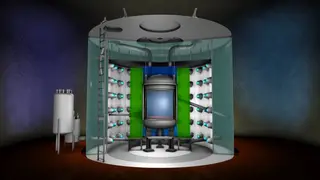
The LUX-ZEPLIN detector represents one of several international efforts to identify dark matter particles. Located in a South Dakota gold mine, this facility joins comparable experiments in Italy and China in the search for weakly interacting massive particles (WIMPs). The September signal, while intriguing, remains far below confirmation thresholds and could represent statistical noise—a pattern familiar to dark matter researchers who have witnessed previous anomalies dissolve under scrutiny. The unexpected energy signature has prompted theoretical reconsideration of how WIMPs might interact with ordinary matter.
Quantum entanglement's practical applications extend beyond fundamental physics research. The Large Hadron Collider's recent detection of entangled Z bosons builds on 2023 findings involving top quarks, suggesting particle colliders could serve as platforms for studying quantum phenomena. These observations may eventually inform development of quantum computing systems and advanced sensing technologies, though translating laboratory findings into commercial applications typically requires years of additional research and engineering refinement.
Scientific breakthroughs in particle physics and dark matter detection could eventually reshape technological capabilities in computing and measurement. However, the preliminary nature of these findings—particularly the dark matter signal well below confirmation standards—means practical applications remain distant. Broader impacts depend on sustained funding for fundamental research, international scientific collaboration, and the gradual process of converting theoretical discoveries into engineered solutions that benefit society.