Produce Industry Licensing Shows Regional Divergence in Third Quarter
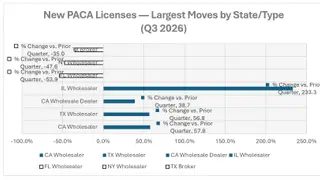
New Produce Agency and Commission Act (PACA) licenses declined 16.8 percent nationally in the third quarter of 2026 to 836, compared to 1,005 in the previous quarter, though this masks significant regional variations. California and Texas bucked the downward trend with wholesaler license increases of 57.8 and 56.8 percent respectively, while Florida and New York experienced sharp declines of 53.9 and 47.6 percent. The data reflects shifting dynamics in produce sector business registration across different U.S. markets.
The produce sector's licensing landscape shifted sharply during the third quarter of 2026, with national registration figures masking divergent state-level trends. Two major agricultural markets moved decisively upward: California's wholesaler registrations more than half, while Texas wholesalers similarly surged. Illinois wholesaler permits tripled, albeit from a minimal baseline. Conversely, Florida and New York experienced substantial contractions in new licensing activity, with Florida's wholesaler registrations falling by more than half and New York declining nearly as steeply.
A secondary indicator—Blue Book platform membership—reveals incomplete alignment with licensing trends. California and Texas are accumulating new government-registered entities that have not yet established trading histories on industry databases, suggesting a lag between official registration and operational visibility. Florida and New York show consistent decline across both metrics, indicating genuine contraction rather than registration delays. This geographic divergence suggests shifting business formation patterns within U.S. produce distribution networks.
The regional licensing splits could signal meaningful shifts in produce supply chain concentration and market accessibility. Buyers and suppliers in California and Texas may encounter more unvetted new counterparties, potentially requiring enhanced due diligence to assess creditworthiness and reliability. Conversely, Florida and New York's declining formation rates might reflect consolidation or reduced entry barriers in those markets. Agricultural lenders, distributors, and retailers evaluating counterparty risk may need to adjust regional strategies based on these varying dynamics of market formation and trading history visibility.