Satellite IoT Market Poised for Sixfold Growth as Connectivity Expands Beyond Terrestrial Networks
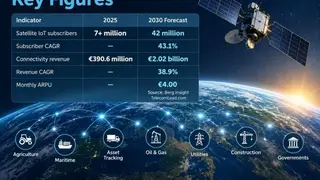
The satellite IoT communications market is experiencing rapid expansion, with subscriber growth forecast to reach 42 million by 2030 from 7 million in 2025, representing a 43.1% annual growth rate. Global satellite IoT revenue is projected to increase from €391 million in 2025 to approximately €2 billion by 2030 as satellite operators address the 90% of Earth's surface lacking terrestrial network coverage. The technology is increasingly vital for industries including agriculture, maritime operations, asset tracking and utilities, complementing traditional cellular networks in remote and underserved areas.
The satellite IoT market's dramatic growth reflects a fundamental geographic constraint: traditional cellular infrastructure reaches only about one-tenth of Earth's surface, leaving vast areas dependent on alternative connectivity solutions. Satellite operators are responding by developing multi-technology platforms that blend their services with terrestrial networks, creating seamless coverage options for industries operating in dispersed locations. The decline in per-user revenue suggests operators are targeting high-volume, low-bandwidth applications rather than premium services.
Established players like Iridium and ORBCOMM are intensifying competition through infrastructure investments and hybrid technologies, while newer LEO entrants are reshaping market dynamics. The projected price reduction to approximately €4 monthly per connection could enable broader adoption in cost-sensitive sectors like agricultural monitoring and maritime tracking, where connectivity was previously economically unfeasible.
Satellite IoT expansion could significantly alter connectivity economics for remote industries and underserved regions, potentially lowering operational costs for agriculture, logistics, and utilities that currently face unreliable or prohibitively expensive alternatives. However, market consolidation around established operators may limit accessibility for smaller enterprises. Infrastructure investment requirements could create competitive barriers, while the emphasis on lower-cost connections may constrain service quality or support capabilities in some markets. The technology's growth may also influence terrestrial network deployment priorities in less profitable areas.