Communities Work to Reduce Light Pollution and Restore Access to Night Skies
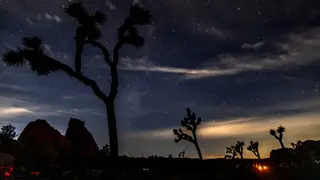
An author and naturalist argues that Earth may have reached peak artificial lighting, with communities beginning to reverse light pollution and reclaim their starry nights. The piece explores humanity's intrinsic connection to the night sky and how reducing excessive outdoor lighting can benefit both people and ecosystems. Growing dark sky movements are encouraging communities to reassess their lighting practices and restore the visibility of celestial phenomena that have become increasingly rare in our artificially illuminated world.
Light pollution has become so pervasive that many people have never experienced a truly dark night sky. Childs' journey across 200 miles of desert terrain over nine nights was designed to document the gradual transition from heavily illuminated urban areas to pristine dark skies, rather than simply comparing the two extremes. By traveling slowly on bicycles at roughly 20 miles daily, he could observe how celestial visibility changes incrementally across different environments.
The Bortle scale provides a scientific framework for measuring sky darkness, ranging across nine levels that help communities and astronomers quantify light pollution in their regions. Childs' exploration corresponded with these nine categories to systematically examine what night skies actually look like at each stage of light pollution, moving beyond anecdotal observations to create a detailed experiential record of this environmental gradient.
Efforts to reduce light pollution could have meaningful implications for public health, wildlife conservation, and cultural reconnection. Communities reassessing outdoor lighting practices may influence energy consumption patterns and nocturnal ecosystem disruptions affecting everything from insect populations to bird migration. Additionally, restored access to night skies might deepen public engagement with astronomy and environmental stewardship. However, balancing practical lighting needs for safety and security with dark sky preservation remains a complex policy challenge requiring coordination between municipalities, businesses, and residents.