Study finds binary star system 16 light-years away could harbor habitable Earth-sized planet
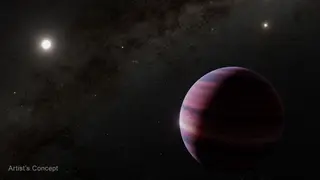
Researchers at the University of California, Riverside modeled the nearby binary star system 70 Ophiuchi, located approximately 16 light-years from Earth, and determined it could potentially support an Earth-sized planet in a stable orbit. The two stars in this system are somewhat smaller and cooler than our sun, yet computational analysis suggests a planet could exist within the habitable zone of one star where liquid water might persist on its surface. Although no planet has yet been confirmed orbiting either star in this system, the findings indicate that such worlds could naturally form in binary star environments similar to those depicted in science fiction.
Researchers employed computational modeling to examine whether planetary formation could occur in the 70 Ophiuchi system, which consists of two stars that are individually smaller and dimmer than our sun. By simulating various orbital positions for a hypothetical Earth-mass world, scientists identified regions where gravitational stability would allow such a planet to persist without being ejected from the system. The study focused on zones where surface temperatures could theoretically permit liquid water, a key ingredient for life as we understand it.
The 70 Ophiuchi system's relative proximity and lengthy observational history made it an ideal candidate for this investigation. Decades of measurement data enabled researchers to construct more accurate models of stellar dynamics, allowing them to test whether the gravitational influence of the secondary star would necessarily destabilize planetary orbits—a question with implications for understanding planetary habitability in binary environments.
This research may influence how scientists assess the potential habitability of exoplanetary systems beyond single-star configurations, potentially expanding the number of candidate worlds worth investigating through future observation. The findings could interest astronomers prioritizing targets for advanced telescopes and space missions seeking biosignatures. For the broader public, the study reinforces that science-fictional scenarios involving multiple-star systems may not be purely imaginative, possibly affecting cultural perspectives on where life might exist in the universe.