Superconducting Motor Technology Faces Practical Barriers in Hydrogen-Powered Aircraft Development
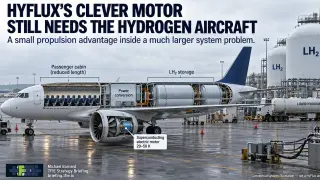
HyFlux is developing a superconducting electric motor cooled by liquid hydrogen aboard future aircraft, potentially achieving power densities exceeding 20 kW/kg for aviation propulsion. While the underlying motor technology appears technically sound and comparable to NASA's research targets, the broader commercialization challenge hinges on whether liquid-hydrogen aviation becomes viable enough to support such specialized propulsion systems. Key uncertainties remain regarding system integration, cryogenic infrastructure, and the complete flight-ready installation weight.
HyFlux's approach uses liquid hydrogen's extreme cold as an active cooling mechanism for a fully superconducting electric motor, enabling potentially superior power-to-weight ratios compared to conventional aviation propulsion systems. The company targets specific power exceeding 20 kW/kg, positioning itself against NASA's partially superconducting motor research achieving 16 kW/kg. However, translating this laboratory advantage into practical aviation requires accounting for additional weight from supporting systems, control electronics, and structural integration necessary for flight certification.
The fundamental challenge extends beyond motor engineering. Commercial viability depends entirely on whether liquid-hydrogen aircraft themselves become economically and operationally feasible at scale. Recent regulatory progress and improved tank designs have addressed some earlier technical objections, yet critical questions persist about passenger capacity preservation, manufacturing feasibility, airport infrastructure requirements, and whether sufficient market demand will emerge to justify specialized hydrogen-compatible propulsion systems.
HyFlux's technology could influence aviation's decarbonization pathway if hydrogen-fueled commercial aircraft materialize. Airlines, aerospace manufacturers, and airport operators worldwide would face investment decisions regarding new infrastructure and aircraft platforms. However, the motor's market impact remains contingent on solving broader systemic challenges in hydrogen production, storage, distribution, and aircraft design—making near-term commercial viability uncertain. Success would primarily benefit early adopters in regions prioritizing aviation emissions reduction.