Saturn Reaches Opposition Tonight; Moon to Occult Jupiter Two Days Later
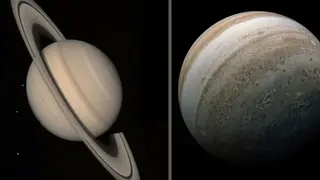
Saturn reaches opposition on October 4, positioning itself on the opposite side of the Sun from Earth and appearing at its brightest with a magnitude of 0.3 at a distance of approximately 784 million miles. The planet will be visible throughout the night from various U.S. cities with specific rise and set times provided for major locations, and its rings will appear largest when viewed through telescopes. A lunar occultation of Jupiter will follow on October 6 when a crescent Moon passes in front of the gas giant.
Saturn's opposition occurs when Earth sits directly between the Sun and the planet, creating optimal viewing conditions. At this positioning, the entire face of Saturn receives sunlight, maximizing its brightness. The planet's rings, which are composed of countless ice and rock particles, become particularly prominent through telescopes during opposition because observers view them at their most expansive apparent angle. This celestial geometry ensures Saturn remains visible throughout the night rather than just during brief windows.
The lunar occultation two days later represents a separate phenomenon where the Moon's orbit carries it directly in front of Jupiter from Earth's perspective. The timing of moonrise—around 2:30 am—means observers in eastern regions have the best opportunity to witness the event near the horizon. Geographic location significantly affects visibility quality, with some areas experiencing the full occultation while mountainous terrain and Pacific time zones will see different presentations of the same cosmic event.
These astronomical events could increase public interest in space observation and amateur astronomy, potentially boosting sales of telescopes and skywatching accessories. Educational institutions may use these occasions to engage students in science learning. The events are accessible to general audiences without specialized equipment, though enhanced viewing benefits from telescopes, which may drive engagement among those seeking deeper engagement with astronomy. Wider cultural awareness of such celestial phenomena could foster broader appreciation for space science and planetary research.