Deep Imaging Reveals Violent Merger History of the Sombrero Galaxy
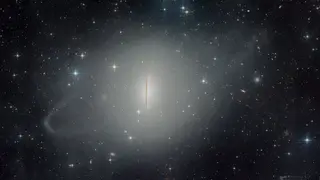
A prolonged exposure of M104, known as the Sombrero Galaxy, uncovered structures including tidal streams and a diagonal ring embedded within its outer halo that suggest a tumultuous past involving galactic collisions. The distinctive galaxy, which spans approximately 150,000 light-years, takes roughly 30 million years for its light to reach Earth and displays a characteristic dark dust band encircling its center. These newly observed features provide evidence that the galaxy formed through mergers of smaller galaxies.
The Sombrero Galaxy represents one of astronomy's most distinctive celestial objects, easily identified by its prominent equatorial dust band that creates its characteristic hat-like appearance. Recent deep-exposure imaging has fundamentally altered our understanding of this galactic system by revealing previously invisible components within its extensive outer region, including previously undetected stellar populations and geometric formations that extend far beyond what standard observations typically capture.
These newly documented features—particularly the tidal streams and embedded diagonal ring structure—serve as archaeological evidence written across the galaxy's stellar halo. Such markers typically indicate gravitational interactions between massive objects, suggesting that M104's current structure emerged from a complex history of collisions involving numerous smaller galactic systems that gradually assembled into the unified structure observed today.
This discovery may enhance our broader understanding of galactic formation and evolution, potentially refining theoretical models used across cosmological research. The findings could influence how astronomers interpret similar structures in other distant galaxies, and may contribute to educational programs seeking to communicate the dynamic nature of the universe. Such research could also support funding discussions for advanced astronomical instrumentation capable of detecting similar hidden structures in other galactic systems.