Lunar Rock Type Identified in Madagascar's Geological Formation
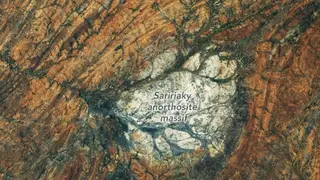
Astronauts aboard the International Space Station photographed a distinctive bright rock formation in southern Madagascar composed of anorthosite, a mineral commonly found on the lunar surface. The Saririaky anorthosite massif formed over 600 million years ago during Earth's geological history and was subsequently deformed by intense pressure and heat during the assembly of the ancient supercontinent Gondwana. This outcrop covering roughly 100 square kilometers provides terrestrial evidence of mineral compositions similar to those studied on the Moon.
Anorthosite rock formations occur in multiple locations across Earth's continents, including areas in Canada, Scandinavia, India, and Madagascar. The Saririaky massif in southern Madagascar stands out as particularly striking due to its bright, highly reflective appearance when viewed from space—a quality it shares with the Moon's luminous highland regions. Scientists determined this 100-square-kilometer formation crystallized during the late Precambrian period, subsequently undergoing dramatic geological transformation.
The rocks encasing the anorthosite display evidence of extreme geological forces that reshaped their structure through heat and pressure. Researchers attribute this deformation to continental collisions occurring as ancient landmasses assembled into the supercontinent Gondwana. Evidence suggests another anorthosite massif nearby may have been separated from Saririaky through large-scale geological stretching during this process, demonstrating the dynamic forces that shaped Earth's continents.
This discovery may benefit lunar research by providing accessible terrestrial analogs for studying rock compositions similar to those on the Moon. Since actual lunar samples collected by Apollo missions remain limited, Earth-based anorthosite deposits allow scientists to conduct ongoing analysis without depleting precious space-derived materials. Additionally, improved understanding of these formations could enhance geological knowledge applicable to planetary science education and future lunar exploration missions.