Chandra Captures Supernova Remnant Dancing Before Milky Way's Central Black Hole
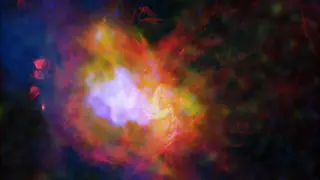
The Chandra X-ray Observatory has revealed a detailed new image of the galactic center, where a supernova remnant called Sagittarius A East takes center stage near the supermassive black hole Sagittarius A*. The remnant, which exploded approximately 10,000 years ago, displays a cooling red ring surrounding a hot blue core and appears to actively interact with the black hole and surrounding environment. Astronomers used specialized techniques to isolate the supernova's X-ray signals and map elements including iron, sulfur, argon, and calcium in this crowded region.
The galactic center represents one of astronomy's most challenging observation zones due to its extreme density and overlapping radiation sources. Sagittarius A East occupies a unique position as the nearest known supernova remnant to our galaxy's core, making it an invaluable laboratory for understanding how stellar explosions interact with the intense gravitational and magnetic environment surrounding supermassive black holes. The research team's isolation technique enables direct analysis of elemental composition across the remnant.
The interaction between the expanding supernova and its surroundings demonstrates dynamic processes shaping galactic architecture. By carving cavities and compressing nearby material, Sgr A East actively sculpts the three-dimensional landscape around Sagittarius A*, revealing that even catastrophic stellar events contribute structurally to their galactic neighborhoods rather than existing in isolation.
This research advances fundamental understanding of stellar physics and galactic dynamics with potential long-term applications in modeling cosmic structure formation. While the findings primarily serve scientific knowledge, improved comprehension of black hole environments may eventually inform theoretical frameworks applicable to exoplanet habitability studies or stellar evolution prediction. The work demonstrates continued returns from aging space observatories, raising considerations about sustained funding for scientific infrastructure that continues yielding discoveries decades after deployment.