Scientists Explore Energy Extraction from Rotating Black Holes via Penrose Process
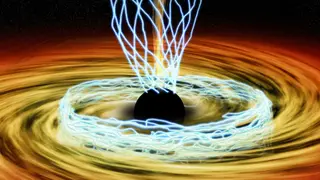
Researchers are investigating whether the Penrose process—a theoretical mechanism for extracting energy directly from rotating black holes—could produce observable signatures detectable through multimessenger astronomy. The process relies on the ergosphere, a region where a black hole's rotation warps spacetime so intensely that nothing can escape the rotational frame, allowing charged particles to gain enormous energy before escaping. This energy extraction differs fundamentally from the typical mechanism where black holes generate power by consuming matter.
The Penrose process represents a fundamentally different energy extraction mechanism from black holes compared to conventional accretion methods. Rather than relying on material spiraling inward and releasing energy through friction and magnetic interactions, this theoretical approach allows particles to gain energy by entering a rotating black hole's ergosphere—a unique region where spacetime itself rotates so violently that escape from the rotational frame becomes impossible, even at near-light speeds.
The research applies this decades-old theory to a practical astronomical scenario involving neutron decay near Sagittarius A*, our galaxy's central black hole. When neutrons decay into charged particles within the ergosphere's magnetic fields, the resulting protons could theoretically reach petaelectronvolt energy scales—vastly exceeding what human-made accelerators achieve. The subsequent collision of these ultra-high-energy protons with surrounding gas would produce distinctive gamma-ray and neutrino signatures potentially detectable by next-generation observatories.
This research could reshape how scientists search for exotic physical processes near black holes and validate relativistic theories in extreme environments. Future observatory upgrades might enable detection of phenomena currently invisible to current instruments, potentially revealing new particle physics previously inaccessible to study. Such discoveries could advance fundamental understanding of gravity and energy dynamics, affecting theoretical frameworks that guide astrophysics research priorities and funding allocation in coming decades.