NASA Uses Advanced X-Ray Imaging to Watch Heat Shield Ablation During Simulated Reentry
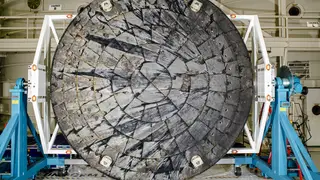
Researchers at NASA and Lawrence Berkeley National Laboratory have developed an experimental setup using the Advanced Light Source to observe heat shield material degradation in real time at temperatures up to 900°C, mimicking the conditions during spacecraft reentry. The ablation process, where material intentionally burns away to protect the spacecraft, has been difficult to simulate accurately, as evidenced by unexpected charring patterns observed during the Artemis I mission. This direct observation capability addresses the gap between predictions and actual performance, potentially improving heat shield design and understanding of atmospheric reentry physics.
NASA and Lawrence Berkeley National Laboratory have successfully demonstrated real-time observation of heat shield degradation using advanced X-ray imaging technology. The research addresses a critical gap between theoretical predictions and actual performance, particularly after the Artemis I mission revealed unexpected material loss patterns that computer models had not anticipated. By heating material samples to 900°C while simultaneously capturing three-dimensional structural changes through X-ray micro-computed tomography, scientists can now observe the precise mechanisms of ablation as they occur.
The study examined multiple heat shield compositions used in current and future NASA missions. Different materials respond distinctly to extreme temperatures: some develop hollow voids as components vaporize, while others create branching channels that affect how thermal gases penetrate the shield. These findings could inform engineering decisions for upcoming crewed lunar missions and eventual Mars exploration efforts.
This advancement may enhance spacecraft safety by improving heat shield design accuracy before missions launch, potentially reducing unexpected failures during atmospheric reentry. Better predictive models could benefit both government space agencies and commercial spaceflight operators developing reentry systems. However, the testing chamber does not fully replicate reentry conditions—notably excluding air velocity effects—suggesting future work remains before complete real-world validation. The cost and accessibility of such specialized facilities may also influence how broadly this technology impacts the aerospace industry.