Hubble Data Reveals Possible Planet Around Dead Star
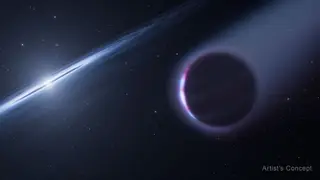
Astronomers analyzing archived images from NASA's Hubble Space Telescope have identified evidence suggesting a second-generation planet may orbit the white dwarf star HS 0209+0832. The discovery, detailed in a Nature Astronomy study, suggests that planetary systems can form not only around living stars but also around the remnants left after a star exhausts its fuel and sheds its outer layers. This finding expands scientists' understanding of planetary formation and indicates that stellar evolution may lead to entirely new planetary systems rather than simply ending the story of existing ones.
White dwarfs represent the final evolutionary stage of stars like our Sun after they consume their nuclear fuel and expel their outer atmospheric layers into space. The detection of unusual chemical signatures in the HS 0209+0832 system suggests that planets may form from this ejected material, fundamentally altering scientific understanding of stellar life cycles. Rather than planetary systems ending when stars die, new worlds could potentially emerge from the remnants and debris left behind.
The research hinges on identifying niobium, an element typically scarce in stellar environments, within archived Hubble observations from 1999. Using modern chemical databases, researchers matched previously unidentified spectral features to niobium's unique signature, providing evidence that heavy elements concentrated in this system originate from stellar death rather than stellar birth—a distinction that challenges conventional models of planetary formation and system evolution.
This discovery may reshape how astronomers model planetary system lifespans and could influence long-term predictions about planetary habitability around aging stars. If validated through further observation, understanding second-generation planets might expand the search space for exoplanets and inform theories about how planetary systems persist across stellar evolutionary timescales. The findings could also inform discussions about Earth's own distant future and the broader prevalence of worlds throughout the universe.