Maya Burial Urn Reveals Rituals Surrounding the Passage to the Underworld
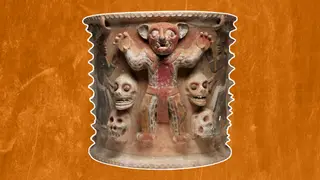
A 1,400-year-old ceramic vessel from Guatemala, created by the K'iche' Maya people, depicts a ruler in jaguar costume surrounded by human skulls and underworld deities. The ornate urn, originally designed to hold ancestral bones for veneration, symbolizes the journey of the deceased into the Maya underworld through the imagery of kapok tree thorns and dark underworld figures. The striking iconography provides insight into Maya burial customs and beliefs about the afterlife.
The K'iche' Maya people created this vessel during the Classic Maya period, a time when elaborate funerary practices reflected complex spiritual beliefs about the afterlife. The urn's imagery combines multiple symbolic elements: the jaguar costume represented the deceased's ability to traverse different cosmic planes, while the kapok tree thorns referenced a central axis connecting the underworld to the living world. Such ceremonial vessels served practical purposes beyond decoration, functioning as repositories for ancestor bones that families maintained and honored across generations.
The artifact's journey to The Walters Art Museum illustrates broader patterns in how pre-Columbian objects enter Western institutions. Anonymous donation in 2008 meant the piece's original archaeological context and provenance remain undocumented, a limitation common among museum collections. Despite this gap in documentation, the urn's visual elements and iconographic program provide researchers with rare insights into Maya cosmology and how communities processed mortality through material culture and ritual practice.
This discovery may interest scholars of Mesoamerican religions, museum professionals studying artifact preservation, and educators incorporating indigenous perspectives into history curricula. Understanding Maya afterlife concepts could foster broader recognition of pre-Columbian intellectual sophistication and challenge historical narratives that minimize indigenous civilizations. For descendant K'iche' communities, such research might affect cultural representation and discussions surrounding repatriation of ancestral objects held in Western institutions.