Telecom Operators Diversify into Cloud, Cybersecurity, and AI Infrastructure for Enterprise Growth
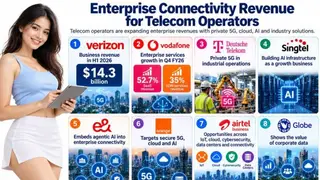
Major carriers including Verizon and Vodafone are expanding beyond traditional mobile services into cloud connectivity, cybersecurity, IoT networks, private 5G, data centers, and AI infrastructure to tap new enterprise revenue streams. Verizon's business segment generated $14.3 billion in H1 2026 revenue, while Vodafone saw digital-services revenue jump 14.2 percent, demonstrating the profitability of these emerging markets. Deutsche Telekom and other operators are deploying private 5G networks in industrial settings and securing multi-billion-dollar infrastructure agreements with technology companies.
Telecom carriers have historically derived revenue primarily from connectivity services, but competitive saturation in consumer mobile markets is pushing them toward higher-margin enterprise solutions. The shift reflects how operators possess existing infrastructure advantages—fiber networks, spectrum assets, and nationwide coverage—that can be repurposed for cloud delivery, data-center operations, and managed security services. Vodafone's digital-services segment now comprises over a quarter of business revenue, while similar carriers are embedding AI capabilities directly into service offerings rather than treating them as separate products.
This diversification may reshape enterprise technology procurement by concentrating multiple services—networking, cloud, security, and AI infrastructure—under fewer vendors. For businesses, this consolidation could streamline vendor management and integration but might also reduce competitive options in specialized markets. Telecom operators gaining deeper access to enterprise data and applications through these expanded services raises questions about data governance and competitive neutrality that regulators and customers may scrutinize as these business models mature.