Teradyne and Bright Machines Partner to Integrate Robotics Into AI Factory Production
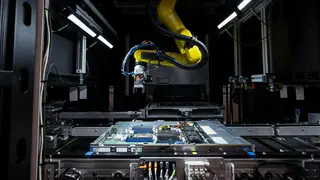
Teradyne has made a strategic investment in Bright Machines and launched a collaboration to combine Teradyne's robotics and testing technologies with Bright Machines' software-defined manufacturing platform. The integration will enable precision robotic assembly, equipment loading, and autonomous material handling across production environments. The partnership aims to help companies building AI infrastructure move faster from design to production while maintaining comprehensive data tracking throughout the manufacturing process.
Teradyne, headquartered in Massachusetts, has demonstrated consistent financial momentum driven substantially by artificial intelligence demand across five consecutive quarters. The company's robotics division, Universal Robots, recently unveiled its latest generation collaborative arm with enhanced AI capabilities. This investment and partnership emerge as companies face unprecedented pressure to manufacture AI infrastructure at scale—a sector characterized by intricate designs, compressed timelines, and demanding quality standards that leave minimal tolerance for production errors or delays.
The integrated system combines three complementary technologies operating on a single production floor: robotic assembly and handling systems, electrical testing equipment, and Bright Machines' software platform. This convergence creates a unified data pipeline tracking decisions from initial design through final assembly and performance validation. The companies suggest this approach could reduce engineering time required to reprogram robots for new tasks, potentially enabling manufacturers to transition between product variations more rapidly than traditional manufacturing methods allow.
This partnership may influence how electronics manufacturers approach production efficiency and quality assurance in emerging AI infrastructure markets. Streamlined automation could benefit companies competing to scale data center equipment quickly while maintaining rigorous standards. However, the deployment of increasingly autonomous systems and rapid task switching may reshape workforce requirements in manufacturing sectors, potentially displacing certain roles while creating demand for new technical expertise. Broader accessibility of such integrated platforms could also affect competitive dynamics among manufacturers serving hyperscalers and AI infrastructure developers.