Perseverance Rover Discovers Unusual Light-Colored Rocks Suggesting Deep Crustal Origin
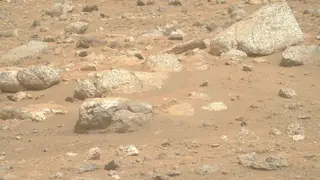
The Perseverance rover identified a widespread field of light-toned boulders in the Lac de Charmes region beyond Jezero crater, an uncommon sight on Mars's dark basaltic surface. Compositional analysis indicates many rocks are gabbro, an igneous rock typically formed deep within planetary crusts through slow magma cooling. The science team is investigating whether these surface boulders eroded from a breccia outcrop, suggesting they may represent material brought up from Mars's deep interior through ancient geological processes.
The Perseverance rover's six-month investigation of the Lac de Charmes region has yielded an intriguing geological puzzle. The abundance of unusually pale boulders contrasts sharply with Mars's typical dark volcanic landscape, prompting detailed compositional analysis. Scientific instruments identified gabbro as a primary component, a rock variety that requires deep crustal conditions and extended cooling periods to form beneath a planetary surface.
The team's working hypothesis centers on a breccia formation mechanism involving violent ancient impacts. If confirmed, these surface deposits would represent material from Mars's interior brought upward through catastrophic geological events, potentially including the impact that created Jezero crater itself. This discovery may provide rare direct evidence of Mars's deeper crustal composition and the planet's dynamic geological history.
This discovery could enhance scientific understanding of Mars's internal structure and early planetary evolution, informing future human exploration planning and resource assessment. The findings may strengthen arguments for additional sample-return missions or subsurface drilling capabilities. For the broader space exploration community, evidence of deep crustal material at the surface could refine models of impact dynamics and planetary formation across the solar system, potentially influencing mission priorities and geological survey methodologies.