Telstar 1 Remains Orbiting After 64 Years, Defying Its Two-Year Design Life
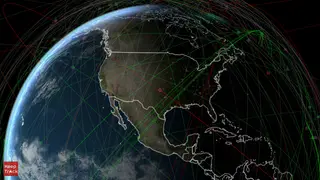
AT&T's Telstar 1, launched in 1962 as the first privately funded satellite to relay transatlantic television and telephone signals, continues to circle Earth in a stable 947 by 5,649 kilometer orbit more than six decades after its deployment. Designed to function for only two years, the 77-kilogram communications satellite has been silent for decades but remains in space due to its high perigee, making it one of the oldest commercial spacecraft still in orbit. The satellite's simple spin-stabilized sphere design proved enduringly effective for power generation and attitude control in the early space age.
Telstar 1 represents a pivotal moment in commercial space history as the first privately financed satellite to demonstrate transatlantic communications capability. Launched by AT&T in 1962, the modest 77-kilogram sphere relied on a straightforward spinning design for power generation and orientation, eliminating the need for complex attitude control systems. This engineering simplicity, combined with its deliberately chosen elliptical orbit, allowed engineers to study the practical requirements and economics of building satellite-based communication networks.
The satellite's remarkable longevity stems largely from its orbital mechanics. With a perigee of 947 kilometers—well above the dense low-Earth orbit region—atmospheric drag poses no near-term threat to its continued presence in space. Recent tracking data shows orbital stability over an 83-day period, with only minute variations attributable to lunar and solar gravitational influences rather than atmospheric decay.
Telstar 1's continued existence may interest space policy makers and orbital debris researchers studying long-term satellite behavior and collision risks in increasingly crowded orbital regions. The spacecraft's stability could provide insights into how aging objects persist in space and inform predictions about the lifespan of modern satellites. Additionally, its visibility through amateur observation equipment may engage citizen scientists and maintain public interest in early space exploration achievements, though the satellite poses minimal practical impact on contemporary space operations or telecommunications.