Record Antarctic Ozone Depletion Surprises Scientists Despite Overall Recovery Trends
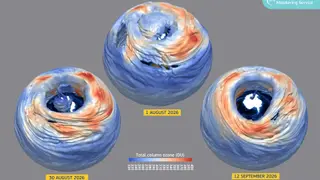
The Antarctic ozone hole reached 10.6 million square miles in September 2026, the second-largest size recorded for that time of year, contradicting expectations of consistent healing. Unusually cold stratospheric temperatures contributed to the expansion, though scientists cannot rule out a potential long-term shift toward larger, more persistent holes in the future. Researchers emphasize the need for continued monitoring despite the year's anomaly, as the overall ozone layer recovery remains on track from historical damage caused by human-produced chemicals.
The Antarctic ozone hole undergoes seasonal fluctuations, expanding during Southern Hemisphere winter and spring as stratospheric temperatures plummet and returning sunlight enables chemical reactions that destroy ozone. This year's anomalously large hole resulted from exceptionally cold conditions in the upper atmosphere rather than increased ozone-depleting substances. Though the current measurement represents only the second-largest September reading on record, scientists acknowledge uncertainty about whether this signals a emerging long-term pattern of persistently larger holes.
The damage observed today stems from chlorofluorocarbons released throughout much of the twentieth century, chemicals with atmospheric persistence lasting 50 to 100 years. Despite the 1989 Montreal Protocol successfully phasing out CFC production, complete recovery of the ozone layer may require approximately six decades from that agreement's implementation.
Scientists and policymakers monitoring ozone recovery may face renewed public concern given the unexpectedly large 2026 measurements, potentially affecting confidence in past environmental interventions. However, the overall recovery trajectory remains intact, suggesting the anomaly reflects natural temperature variability rather than policy failure. Continued scientific monitoring could help distinguish between temporary fluctuations and genuine shifts in ozone dynamics, information that may shape public communication about environmental remediation timelines and the long-term effectiveness of international environmental agreements.