Physicist wins Nobel Prize for detecting cosmic neutrinos using Antarctic ice detector
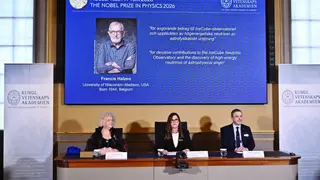
Francis Halzen of the University of Wisconsin–Madison has been awarded the 2026 Nobel Prize in Physics for his work detecting high-energy neutrinos from distant cosmic sources using the IceCube Neutrino Observatory at the South Pole. Neutrinos are subatomic particles that rarely interact with matter and pass through the universe in abundance, serving as messengers that reveal information about cosmic phenomena inaccessible through other detection methods. Halzen proposed using Antarctic ice as a neutrino detector in 1988 and led an international collaboration to build the facility, which uses thousands of light sensors buried kilometers underground to detect the faint radiation produced when neutrinos interact with the ice.
The IceCube Observatory represents a decades-long scientific undertaking that transformed an ambitious concept into a functional instrument for studying the universe. When Halzen first conceived the idea in 1988, the feasibility of detecting rare cosmic neutrinos through ice seemed uncertain to most observers. The completed facility, buried deep beneath Antarctica's frozen surface, comprises thousands of sensitive light detectors positioned to capture the faint signatures produced when high-energy neutrinos collide with ice molecules. Early skepticism proved unfounded when the observatory successfully detected its first cosmic neutrinos within two years of completion.
The detector's subsequent achievements have expanded our understanding of cosmic sources. A 2017 breakthrough identified TXS 0506+056, a distant blazar, as the first confirmed origin point for a detected high-energy cosmic neutrino. More recently, the facility detected neutrinos originating from within our own galaxy, a feat complicated by background noise from stronger universal radiation. These discoveries demonstrate how neutrino detection provides insight into violent cosmic phenomena otherwise inaccessible through conventional astronomical observation.
This award may encourage increased investment in fundamental physics research and large-scale international scientific collaborations. The recognition could inspire younger researchers to pursue detection-based astronomy and particle physics, potentially advancing our understanding of the universe's most energetic phenomena. Scientific institutions worldwide may benefit from heightened public interest in high-energy physics. Additionally, the prize underscores how long-term, resource-intensive projects with uncertain outcomes can yield transformative discoveries, potentially influencing how governments and funding bodies evaluate experimental proposals in fundamental science.