Security Platform Aembit Adds Safeguards for Personal AI Agents in Enterprise Settings
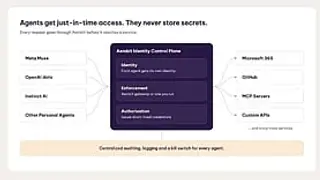
Aembit announced immediate support for controlling personal artificial intelligence agents' access to enterprise systems, available at no additional cost to existing customers. The feature uses blended identity technology that combines both the agent's identity and the employee it represents, allowing organizations to apply access policies, issue temporary credentials, and maintain centralized logging of agent activity. This addresses security risks as personal AI tools like Meta Muse and OpenAI Dots gain adoption in workplace environments where they can access sensitive data and applications.
Aembit's announcement reflects a growing intersection between consumer AI tools and workplace environments. As employees increasingly adopt personal AI assistants like Meta's Muse and OpenAI's Dots to enhance productivity, these tools inevitably gain access to corporate resources—email systems, cloud applications, code repositories, and internal platforms—through employee login credentials. This creates a security blind spot for enterprise teams who lack visibility into agent activities and cannot easily manage or revoke agent permissions independently.
The company's solution establishes dual-layer identity verification that treats the AI agent and its human operator as separate entities within access control systems. This approach enables organizations to issue temporary credentials that automatically expire, maintain detailed audit trails distinguishing agent actions from employee actions, and disable specific agents without affecting employee access. The feature launches at no additional cost to existing customers, positioning it as an immediate security measure for enterprises already managing AI proliferation in their workforce.
The expansion of personal AI agents into enterprise settings may create new operational efficiencies while introducing compliance and data protection challenges. Security teams could face increased complexity managing access across multiple agent platforms without standardized controls. Organizations in regulated industries handling sensitive data may find that existing governance frameworks prove inadequate for agent-based access patterns. Conversely, solutions enabling granular agent identity management could allow companies to realize productivity gains from AI adoption while maintaining security oversight—potentially reshaping how enterprises balance innovation with risk mitigation.