AT&T Forms Major Fiber Joint Venture to Accelerate U.S. Broadband Expansion Beyond Traditional Markets
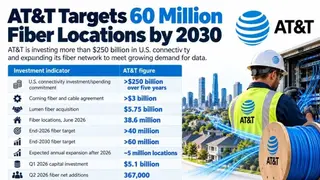
AT&T has established a 50-50 joint venture with investment firms Global Infrastructure Partners and Canada Pension Plan Investment Board to rapidly expand fiber-optic infrastructure across the United States. The partnership combines existing fiber assets acquired from Lumen Technologies with AT&T's wholesale fiber operations, starting with nearly 5 million locations and targeting 60 million by 2030. The structure allows AT&T to pursue capital-light expansion outside its traditional service territories while using the combined company's construction capabilities to accelerate deployment.
AT&T's joint venture represents a strategic shift in how the company finances its broadband infrastructure rollout. By partnering with institutional investors GIP and CPP Investments, AT&T gains access to capital without bearing the full financial burden of expansion into new markets outside its existing footprint. The merger of Forged Fiber 37—created through AT&T's acquisition of Lumen's fiber business—with the existing Gigapower wholesale operation creates a unified construction and deployment platform.
The partnership's scope is substantial: starting with nearly 5 million locations, the JV targets rapid acceleration toward AT&T's broader 60 million location goal by 2030. This dual approach allows AT&T to maintain approximately 50 million locations through direct ownership while using the JV as its primary expansion vehicle in unfamiliar territories, reducing execution risk in new markets.
This venture could accelerate fiber availability in underserved areas by leveraging institutional capital and specialized construction expertise. Consumers in markets outside AT&T's traditional service regions may gain access to high-speed broadband sooner than traditional deployment timelines would allow. However, the open-access wholesale model could create competitive dynamics that warrant monitoring—including how pricing and service terms affect smaller competitors and whether broadband affordability improves across income levels.