Exploration Reveals Solar System's Moons as Geologically Extreme Worlds
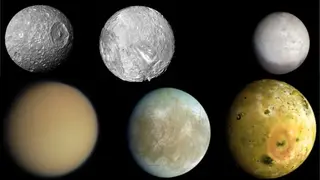
Many moons throughout the solar system exhibit dramatically different characteristics than Earth's moon, featuring active geological processes including volcanic activity, geysers, and subsurface oceans. Io, orbiting Jupiter, stands out as the solar system's most volcanically active body, with its surface continuously reshaped by tidal heating-driven eruptions that send material hundreds of miles into space. These diverse moons represent some of the most dynamic and complex worlds in our solar system and remain subjects of scientific interest regarding their potential habitability.
Jupiter's moon Io represents an extreme example of geological activity in our solar system. The constant reshaping of its surface occurs through a mechanism fundamentally different from Earth's volcanism—tidal forces from Jupiter's gravitational pull generate internal heat that drives persistent eruptions, completely erasing impact craters and creating sulfur-rich landscapes dotted with lava lakes.
Beyond Jupiter, other moons demonstrate equally remarkable characteristics. Saturn's Enceladus ejects water vapor from its south pole, feeding the planet's ring system, while Europa harbors a subsurface ocean potentially containing more water than Earth's oceans. These diverse geological processes suggest moons may be far more dynamic than previously understood.
This research could influence long-term space exploration priorities and funding decisions, as understanding moon geology may reveal promising environments for seeking extraterrestrial life or future resource utilization. Scientific interest in these worlds may accelerate development of advanced robotic missions to study subsurface oceans and active geological systems. Educational and public engagement with these discoveries could also shape how societies view planetary science's importance in expanding human knowledge of our cosmic neighborhood.