Compact Laser-Plasma Technology Achieves Stable Free-Electron Laser Operation
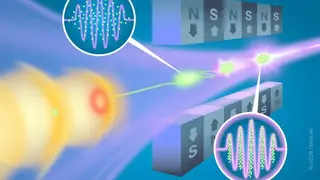
Researchers at Helmholtz-Zentrum Dresden-Rossendorf and Synchrotron SOLEIL demonstrated the first reliable operation of a compact free-electron laser using plasma acceleration, reducing the required equipment size by approximately 1000 times compared to conventional designs. The breakthrough involved using infrared laser pulses to accelerate electrons through a millimeter-thin gas stream, allowing them to reach near-light speeds in just millimeters rather than kilometers of distance. This achievement could significantly expand access to free-electron laser technology by making these powerful research tools smaller and more affordable.
Free-electron lasers generate extraordinarily bright, brief pulses of light by accelerating electrons to near-light speeds and then forcing them through magnetic arrays that cause them to emit coherent radiation. These machines have become essential instruments for materials science and molecular research, yet their massive scale—sometimes extending kilometers—severely limits how many institutions can operate them. The bottleneck creates significant waiting periods for researchers seeking access to experimental time.
The laser-plasma approach achieves electron acceleration through a fundamentally different mechanism: infrared laser pulses ionize a thin gas stream into plasma, and the resulting electromagnetic waves carry electrons to high energies within millimeters rather than kilometers. This dramatic size reduction hinges on precise control of complex, nonlinear interactions between laser and plasma that researchers have spent years perfecting. The German and French teams' demonstration of stable, reproducible operation in the high-gain regime—where radiation amplifies exponentially—represents a critical proof-of-concept that this miniaturization pathway is viable.
If compact laser-plasma FELs mature into reliable, deployable systems, they could democratize access to ultraviolet and extreme ultraviolet light sources currently concentrated at major facilities. Universities and smaller research institutions might eventually operate their own systems, potentially accelerating discovery in materials science, nanotechnology, and semiconductor manufacturing. However, several years of additional development remain before such instruments could meaningfully supplement existing large-scale facilities, and widespread adoption would depend on achieving comparable stability and performance benchmarks.