Mercedes-Benz Accelerates EV Market Share With Over 78,000 Electric Vehicles Sold in Third Quarter
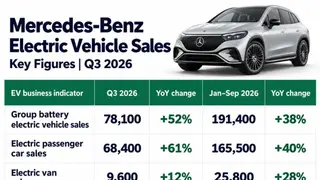
Mercedes-Benz sold 78,100 battery electric vehicles in the third quarter of 2026, representing a 52 percent year-over-year increase driven by strong demand for the electric GLC SUV and new model launches across European and global markets. Electric vehicles now account for 16.8 percent of the company's passenger car sales, up significantly from the prior year, while electrified vehicles including plug-in hybrids represent one-quarter of total sales. The growth occurred despite overall company vehicle sales declining 6 percent due to challenging conditions in China.
Mercedes-Benz's electric vehicle expansion reflects deliberate product strategy across multiple vehicle categories. The company introduced or expanded availability of electric variants spanning compact cars, mid-size saloons, and SUVs throughout the quarter, with popular models like the GLC seeing production more than triple from the previous quarter. Manufacturing capacity was significantly ramped up to manage demand, with three major European plants operating extended shift schedules to handle order backlogs extending into 2027.
The regional performance gap underscores market divergence, with European demand for electric vehicles surging 78 percent year-over-year while overall company sales declined due to weakness in China. This geographic split illustrates how regulatory environments and consumer preferences vary substantially by region, allowing Mercedes-Benz to achieve record electric penetration rates in Europe even as the broader business faced headwinds.
Mercedes-Benz's accelerating EV sales could influence automotive industry investment patterns, with other manufacturers potentially intensifying their own electrification timelines. Consumers in markets with strong infrastructure and regulatory support may gain expanded model choice at premium price points, while supply constraints—evidenced by sold-out inventory through 2027—could delay vehicle delivery timelines. The shift also reflects labor implications for traditional powertrain manufacturing, though production ramping at existing plants suggests workforce redeployment rather than immediate contraction.