Mars Cloud May Form Without Dust Particles, Simulations Suggest
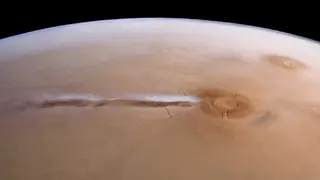
The Arsia Mons Elongated Cloud is a water-ice plume that appears downwind of a tall Martian volcano and can stretch about 1,800 km in a single day. New simulations indicate it may form through homogeneous nucleation, with water vapor freezing directly into ice without dust or other particles. This mechanism has not been confirmed before in any planetary atmosphere and would require extreme supersaturation.
The cloud appears in the Martian southern hemisphere during spring and summer, emerging each morning for months. ESA's Mars Express first photographed it in 2018 and has tracked it since. Arsia Mons, roughly 20 km tall, is the southernmost of the Tharsis Montes shield volcanoes. Researchers had classified the plume as an orographic cloud, the type produced when wind crosses elevated terrain, but models built on that idea failed to match observations.
Only after adding a theoretical process did simulations reproduce the cloud. The mechanism demands humidity far beyond Earth levels, and the team reports its findings in Nature Geoscience.
If confirmed, the finding could reshape how scientists model cloud formation on Mars and elsewhere, affecting atmospheric researchers and mission planners who depend on such models. Spacecraft observations may need to account for ice clouds forming without dust seeds, which could shift estimates of water transport. For the wider public, it offers another reminder that planetary atmospheres can behave unexpectedly, though practical consequences remain distant and speculative.