Why Standard Crypto Indicators Struggle During Liquidation Cascades
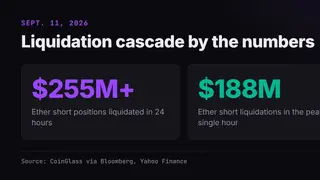
The article examines why conventional oscillators lag during rapid crypto liquidation events because they rely on completed bars. It cites the September 11, 2026 cascade, when Ether short liquidations exceeded $255 million in 24 hours and Bitcoin short liquidations reached about $172 million. The piece discusses multi-timeframe regime-detection scripts intended to reduce candle latency and data errors during such flushes.
On 11 September 2026, Ether short liquidations surpassed $255 million in a day, with about $188 million occurring in one hour, while Bitcoin short liquidations totaled roughly $172 million. The event echoed a late-August squeeze that produced the biggest recorded Bitcoin short-liquidation wave since at least 2021.
Because RSI and ATR depend on completed candles, a one-hour reading can wait nearly an hour after a flush begins. Multi-timeframe regime scripts instead compare lower-timeframe volatility with higher-timeframe momentum, shortening that delay, though they cannot erase exchange-feed latency or missing-data errors.
Traders using standard oscillators may react late during liquidation cascades, potentially amplifying losses or missed exits. Exchanges and tool developers could face pressure to improve data handling and multi-timeframe alerts. For the wider public, repeated sharp crypto swings may reinforce caution about leveraged products, though the direct effects are likely concentrated among active market participants.