NASA Taps L3Harris for LISA Gravitational-Wave Telescope Test Unit
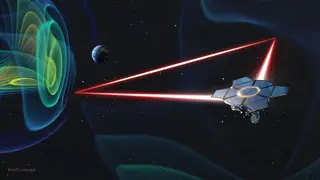
NASA is moving ahead with an all-glass telescope for the LISA gravitational-wave observatory by having L3Harris build an Engineering Test Unit. The ESA-led LISA mission, planned for the mid-2030s, will use three spacecraft and infrared lasers to detect minute changes in distance caused by passing gravitational waves. NASA is supplying the telescopes and other hardware and support.
NASA chose L3Harris to build an Engineering Test Unit for LISA’s all-glass telescope. This is the final pre-flight stage before manufacturing flight hardware. ESA leads LISA, planned for the mid-2030s. Three spacecraft will fly in an Earth-following formation, creating a triangular laser array with sides roughly 2.5 million kilometers long. Each spacecraft will carry two telescopes.
The telescopes will be made from Zerodur, an amber ceramic-glass that resists shape changes across temperature extremes. L3Harris delivered a prototype in 2024; a metal structural model came in June. NASA supplies telescopes, hardware, and engineering and scientific support. LISA seeks low-frequency gravitational waves from sources such as giant black hole mergers and compact stellar objects.
LISA’s progress could shape how scientists and engineers study gravity, potentially expanding knowledge that may influence future astronomy, physics, and space-industry work. The mission may also strengthen international collaboration and create demand for precision manufacturing and testing expertise. Broader society might benefit indirectly through improved measurement technologies and inspiration, though concrete everyday applications could remain distant and uncertain.