Diplodocus Fossils Found in Spain, Far From Its Known Range
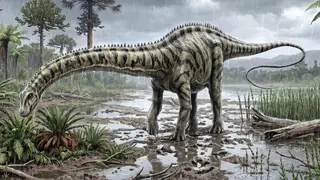
Paleontologists working at La Tejería in Teruel, Spain, uncovered 14 well-preserved tail vertebrae and chevron bones from a sauropod. The fossil's anatomy and evolutionary analyses place it within Diplodocus, close to Diplodocus hallorum, making it the first confirmed Diplodocus material outside North America. The discovery extends the genus's known range into Europe near the end of the Jurassic and adds evidence about how giant dinosaurs dispersed between continents.
Researchers from Fundación Dinópolis studied 14 tail vertebrae and chevron bones from La Tejería, El Castellar, Teruel. The specimen dates to the Late Jurassic, roughly 150 million years ago. Previously, verified Diplodocus fossils came only from the Morrison Formation in the western United States. This Spanish find is a notably complete European diplodocid skeleton.
Anatomical traits—air spaces in the vertebrae, lower grooves, forked chevrons with medial fossae, and long vertebral bodies lacking lateral ridges—helped identify it. Evolutionary tests using maximum parsimony and Bayesian inference grouped it with Diplodocus, near D. hallorum. Co-author Alberto Cobos noted the animal was about 25 meters (82 feet) long.
This discovery may interest museum visitors, educators, and paleontology researchers by adding a European chapter to a familiar dinosaur's story. It could boost local scientific tourism around Teruel and support public engagement with Jurassic ecosystems. For scientists, it may encourage further fieldwork and international collaboration on Late Jurassic dispersal. These effects are speculative; the find's main impact is likely cultural and scientific rather than immediate economic or political.