Russia's Last US-KMO Missile-Warning Satellite Drifts Below Geostationary Belt
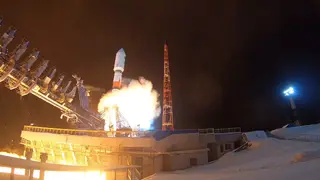
COSMOS 2479 is a Russian geosynchronous early-warning satellite launched on March 30, 2012, from Baikonur aboard a Proton-K/DM-2. It carries an infrared telescope designed to detect ballistic missile launches against Earth's background. More than 14 years after launch, it appears uncontrolled, drifting roughly 31 km below the geostationary belt while Russia's missile-warning duties have shifted to the newer EKS system.
COSMOS 2479 was the final US-KMO spacecraft, carrying the Oko-1 No. 7128 infrared payload. Unlike earlier US-K satellites in elliptical Molniya orbits, US-KMO moved missile-launch sensing to geosynchronous altitude and looked downward, allowing detection over oceans and land against Earth’s thermal background. It launched from Baikonur’s Site 81, Pad 24, atop a Proton-K/DM-2.
Built by NPOL/Lavochkin and KOMET on the Prognoz bus, it was a 5 m stepped cylinder, 2 m wide, spanning 10 m with solar arrays. Launch mass was 2,580 kg; dry mass 2,200 kg. Its catalog radar cross section of 12.6 m² makes it a sizable object near GEO. Designed for 5–7 years, it has now spent more than 14 years in orbit.
An uncontrolled, bus-sized object drifting below and through the geostationary belt could complicate space traffic management for commercial and government satellite operators. Its repeated crossings and changing close-approach geometry may require additional tracking and collision-avoidance attention, potentially affecting insurers and services that rely on GEO satellites. Because it appears inert and Russia’s warning role has moved