Student's High School Work Uncovers Three Odd Dwarf Galaxies
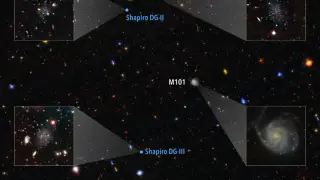
Julian Shapiro, now an astrophysics undergraduate at UC Berkeley, identified three unusual dwarf galaxies near the spiral galaxy M101 while still in high school. The objects, named Shapiro I, II, and III, show star-formation behavior that challenges expectations. Shapiro is continuing follow-up research in Alexei Filippenko's group, and his work underscores how public telescope archives can enable discoveries by young researchers.
Julian Shapiro spotted three dwarf galaxies near the spiral M101 while still in high school. They are called Shapiro I, II, and III. Although isolated dwarfs usually keep forming stars, these objects show unusually low activity. Shapiro proposes they may be "backsplash" candidates: galaxies that once approached a large neighbor, lost gas under its influence, and were later flung outward.
His analysis used simulations to argue that an external cause suppressed their star formation. Such backsplash systems are expected under lambda-cold dark matter cosmology and should not be rare, yet local examples have been hard to identify. Shapiro published the work in The Astrophysical Journal and continues related research at UC Berkeley.
This story may encourage students without professional lab access to explore public telescope archives. Educators and mentorship programs could use Shapiro's example to show that high school research can contribute to astrophysics. The broader public may gain awareness of how open data and archival surveys support discovery. It may also prompt researchers to consider young collaborators, though such outcomes depend on mentorship, resources, and sustained follow-up.