Hubble Captures Galaxy NGC 4698 With a Perpendicularly Rotating Core
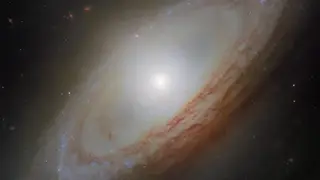
Hubble’s image of NGC 4698 shows a spiral galaxy roughly 55 million light-years away in Virgo whose central bulge is oriented at a right angle to its main disk. Stars and gas in the core rotate in a different plane from the rest of the galaxy, suggesting that material captured from outside may have formed a tilted central disk. A short hydrogen tail also points to a past encounter or merger.
NGC 4698 is a spiral galaxy in Virgo, roughly 55 million light-years away and one of over a thousand members of the Virgo Cluster. Hubble’s view shows a thin disk whose spiral arms appear mainly near its outer edge, creating an outer ringlike pattern marked by dust and scattered blue stars.
Its elongated central bulge lies at a right angle to that disk. Stars and gas close to the core rotate in a separate plane, and a short hydrogen tail suggests a past minor merger may have delivered material that settled into this tilted center. A supermassive black hole, millions of solar masses, shows signs of feeding.
This finding may sharpen public curiosity about how galaxies evolve and could strengthen appreciation for Hubble and future observatories. Astronomers and educators could use NGC 4698 as a clear example of mergers shaping galactic structure, while planetarium visitors and students may encounter it in explanations of the Virgo Cluster. Its impact is likely cultural and scientific rather than immediate, but it may help sustain interest in space exploration.