Boston Dynamics explains design choices behind Atlas's new hand
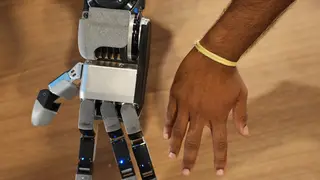
Boston Dynamics has shared more details about its redesigned four-fingered humanoid hand for Atlas, which has 13 degrees of freedom and direct actuation and was built for mass manufacturing. In an interview, Alberto Rodriguez said the hand uses 13 identical encapsulated actuators, avoids fragile cables across joints, and supports high-fidelity simulation for sim-to-real reinforcement learning. The design keeps the ability to handle objects over 100 lb while dropping the pinky finger and reducing gripper size.
Boston Dynamics has disclosed more about the four-fingered hand it created for Atlas. The unit has 13 degrees of freedom, uses direct actuation, and was engineered with mass production in mind. It omits the pinky and shrinks the gripper while retaining the ability to manipulate loads exceeding 100 lb.
Alberto Rodriguez, who leads robot behavior for Atlas, said the hand relies on 13 identical sealed actuators and avoids delicate cables spanning joints. The design supports detailed simulation for reinforcement learning transfer. Boston Dynamics weighed dexterity, strength, durability, cost, repair, and sensing, and chose in-house development because hands are central to humanoid value.
If humanoid hands become more durable and manufacturable, they may eventually take on repetitive or heavy material handling in factories and warehouses. That could reduce physical strain for some workers, while also changing job tasks and requiring new training. Researchers and robotics firms may benefit from simulation-friendly designs that speed iteration. Broader adoption will depend on cost, reliability, and safety.