JWST Tracks Shifting Water Clouds on a Nearby Cold Brown Dwarf
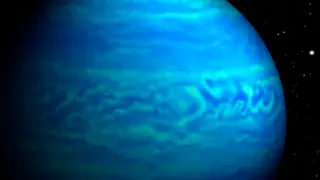
Astronomers used the James Webb Space Telescope to collect time-resolved spectra of WISE 0855, the coldest known brown dwarf, located about 7.4 light-years away. Observations taken every 15 minutes over 11 hours revealed water clouds growing thicker and thinner while deeper atmospheric gases moved. The results offer a rare look at how clouds and chemistry behave in a cold atmosphere beyond the Solar System.
WISE 0855 is the coldest brown dwarf known, roughly twice Jupiter’s mass and close to Jupiter’s size. Its temperature, about 265 K, allows water clouds to form high in the atmosphere while preventing ammonia from condensing. Located only 7.4 light-years away, it offers a nearby test case for cold-atmosphere physics.
Using Webb’s NIRSpec, researchers recorded spectra every 15 minutes across 11 hours. Unlike simple brightness measurements, these data let them separate cloud effects from chemistry and temperature. Their modeling indicates water clouds and chemical mixing are both needed to explain the observed spectrum. The study is slated for the Astronomical Journal.
This result may deepen public and scientific interest in exoplanet atmospheres, benefiting astronomers, educators, and science communicators by providing a vivid example of weather beyond the Solar System. It could also support future telescope observing strategies and atmospheric modeling, potentially improving how researchers interpret distant gas giants. For general audiences, it may make abstract exoplanet science more tangible, though direct societal or technological effects are likely indirect and long-term.