Balloon-Borne SUNRISE III Sharpens Views of the Sun's Magnetic Chromosphere
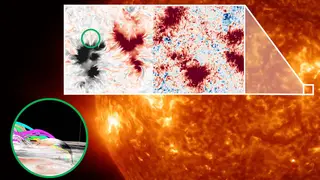
The SUNRISE III mission used a helium balloon at about 35 km altitude to lift a 1-meter solar telescope and other instruments above much of Earth's atmosphere. Its SCIP instrument measured full Stokes polarimetry to map magnetic field directions and strengths across multiple layers of the solar chromosphere. Three papers in Astrophysical Journal Letters report unexpected narrow magnetic threads in the Quiet Sun, with strengths around 10 to 20 Gauss and occasional polarity reversals.
SUNRISE III flew in 2024 beneath a helium balloon at roughly 35 km, carrying a 1-meter solar telescope and the SCIP spectropolarimeter. Full Stokes polarimetry let researchers reconstruct magnetic field strength and direction across several chromospheric layers. Three papers in Astrophysical Journal Letters describe the results.
In the Quiet Sun's chromosphere, SCIP found narrow magnetic threads about 725 km wide with fields of 10–20 Gauss, sometimes reversing polarity relative to the surrounding canopy — "opposite-polarity intrusions." Simulations using MURaM-ChE matched these as twisted flux ropes, 2,000–7,000 km long, the structures linked to flares.
This research may mainly affect solar physicists and space-weather forecasters, since clearer chromospheric magnetic maps could improve models of how energy moves through the Sun's atmosphere. Better understanding of small-scale reconnection might eventually sharpen predictions of flares and the disruptions they can cause to satellites, power grids, and communications. For the wider public, practical benefits would likely arrive slowly and indirectly, through incremental forecasting improvements rather than any immediate change.